A maqam synthesizer with qanun levers
Draw across the strings to play. Every course has a lever, as on a qanun, and the levers hold the quarter tones of the maqam you choose. Move a lever and the maqam moves with it; underneath, a drone keeps the qarar.
Draw across the strings to play. The levers hold the maqam’s quarter tones; move one and the maqam moves.
An instrument that exists only here, as a concept. Nothing sounds until you touch it.
Bayati on Dukahبياتي على الدوكاه
Jins Bayati on Dukah, then Jins Nahawand on Nawa
This browser can’t play the instrument’s sound.
Move to
Draw across the strings, or press A to K: A is always the qarar. Click a lever or drag it along its slot. 1 to 8 change maqam, the arrows choose a move, Space damps, Esc mutes.Swipe across the strings. Tap a lever to move it one notch, or drag it. Tap the skin at the bottomon the right to damp.
How to play it
With a mouse or a finger, press a string to pluck it, or draw across several to strum. Where you pluck changes the sound: close to the skin on the rightat the bottom it is bright and thin, towards the middle it is round. Hold a string and slide along it to lean the note, the way an oud player shades a Sikah.
The moves above the strings are the modulations players reach for most: resting on another note, or moving one or two levers in the middle of a phrase.
The numbers 1 to 8 jump straight to a maqam, in the order of the buttons above the strings.
The home row is the maqam. A is always the qarar, the note the maqam rests on, and A to K climb to its octave, the jawab.
T Y U I reach the highest courses; M N B V C go down beneath the qarar.
The space bar damps everything, like a palm laid on the strings. The drone keeps going; Esc stops it too.
Why a synthesizer needs levers
A qanun player changes maqam with the left hand. Under every course of three strings sits a row of small metal levers, the ’urab, and raising or lowering one changes the length of string that sounds by a fraction of a tone. A taqsim can pass from Rast to Bayati to Hijaz and back without a pause, because the levers move while the right hand keeps playing.
On most keyboards the quarter tones live in a menu. You pick a scale, the keys retune, and the change happens out of sight. The Ghawr puts a lever beside every course instead. You can read the maqam in the lever row before you play a note, and you can change one note of it in the middle of a phrase.
On the instrument the levers are brass and they click into five notches: flat, half-flat, natural, half-sharp, sharp. Here they are drawn, and they slide by themselves when you choose a maqam, so you can watch which notes changed.
Named after the rift
Al-Ghawr is the Arabic name of the Jordan Rift Valley, and in Jordan it is simply what people call the valley floor: the long trough that runs from the Jordan Valley through the Dead Sea and down Wadi Araba to the Gulf of Aqaba. Its floor is the lowest land on earth. The shore of the Dead Sea lies more than 430 metres below sea level, and a little lower every year.
The rift follows the Dead Sea Transform, the line along which the Arabian plate slides north past the African plate, a few millimetres a year. Over millions of years the two sides have moved about 105 kilometres past each other.
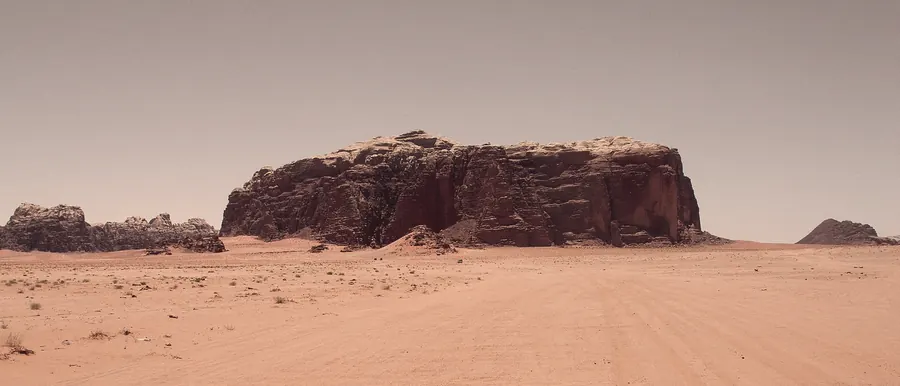
The instrument’s colours come from there: the green of the irrigated valley floor, the pink of the granite above Aqaba, the red of the Umm Ishrin sandstone in Wadi Rum.
In maqam, the qarar is the note a melody comes home to. In Arabic it is also the settled ground at the bottom of a deep place. An instrument named after the lowest land on earth had to keep its qarar, so the Ghawr holds a drone under every maqam, on the qarar, and moves it when the maqam moves.

What is inside the case
A shallow trapezoid of folded aluminium with walnut ends, 58 centimetres along the front: a qanun’s outline cut down to fifteen courses. It sits on a table or across your knees.
- CoursesFifteen steel touch strips, each reading where and how hard you pluck. Draw a finger across them and they strum.
- LeversBrass, one to a course, five notches each, a magnet in every notch and a sensor under the slot that tells the engine where the lever sits.
- EngineA small processor under the strings models three strings for every course, with twelve courses ringing at once, and passes them through a body and a room. The drone has oscillators of its own.
- RosetteA speaker behind a grille drilled like an oud’s rosette, for practising without an amplifier.
The first batch
Twenty-four instruments, built and tuned in the workshop in Jabal Al-Hussein. 1,480 dinars each, collected from the workshop or delivered anywhere in Jordan for 6 dinars.
Joining the list costs nothing.